Published by:
CGP EDU Academic Team
Published on: September 12, 2026
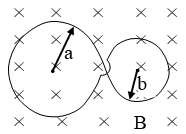
A plane loop is shaped in the form as shown in figure with radii a = 20 cm and b = 10 cm and is placed in a uniform time varying magnetic field B = B 0 sin ω t, where B 0 = 10 mT and ω = 100 rad/s. Find the amplitude of the current induced in the loop if its resistance per unit length is equal to 50 × 10 –3 Ω /m. The inductance of the loop is negligible
Text Solution
Verified by ExpertsThe correct answer is:
A
Step 1: Identify the area of the loop. The loop is composed of two concentric circles with radii a = 0.2 m and b = 0.1 m. The area (A) of each is given by:
A_{outer} = \pi a^2 = \pi (0.2)^2 = 0.04\pi \, m^2
A_{inner} = \pi b^2 = \pi (0.1)^2 = 0.01\pi \, m^2
Effective Area = A_{outer} - A_{inner} = 0.04\pi - 0.01\pi = 0.03\pi \, m^2
Step 2: Calculate the rate of change of magnetic flux (\Phi) through the loop. The magnetic field (B) is given by B = B_{0} \sin(\omega t). Therefore, the magnetic flux is:
\Phi = B \cdot A = B_{0} A \sin(\omega t) = (10 \times 10^{-3})(0.03\pi) \sin(100 t).
Step 3: Differentiate the flux to find the induced emf (\varepsilon):
\varepsilon = -\frac{d\Phi}{dt} = -\frac{d}{dt}\left[(10 \times 10^{-3})(0.03\pi) \sin(100 t)\right] = -\left(10 \times 10^{-3})(0.03\pi) (100 \cos(100 t)) = -0.03 \pi\, \cos(100 t).
Step 4: The amplitude of the induced emf is:
\varepsilon_{max} = 0.03\pi \, V.
Step 5: Using Ohm's law (V = IR), where R is the resistance and can be calculated by R = \rho \frac{L}{A}, where \rho is the resistance per unit length and L is the perimeter of the loop.
The perimeter (L) of the loop is:
L = 2\pi a + 2\pi b = 2\pi(0.2) + 2\pi(0.1) = 0.6\pi\, m.
Therefore, the total resistance:
R = (50 \times 10^{-3})(0.6\pi) = 0.03\pi \, \Omega.
Step 6: Finally, we can find the amplitude of the current (I) using Ohm's law:
I = \frac{\varepsilon_{max}}{R} = \frac{0.03\pi}{0.03\pi} = 1 \, A.
Therefore, the amplitude of the current induced in the loop is 1 A.
A_{outer} = \pi a^2 = \pi (0.2)^2 = 0.04\pi \, m^2
A_{inner} = \pi b^2 = \pi (0.1)^2 = 0.01\pi \, m^2
Effective Area = A_{outer} - A_{inner} = 0.04\pi - 0.01\pi = 0.03\pi \, m^2
Step 2: Calculate the rate of change of magnetic flux (\Phi) through the loop. The magnetic field (B) is given by B = B_{0} \sin(\omega t). Therefore, the magnetic flux is:
\Phi = B \cdot A = B_{0} A \sin(\omega t) = (10 \times 10^{-3})(0.03\pi) \sin(100 t).
Step 3: Differentiate the flux to find the induced emf (\varepsilon):
\varepsilon = -\frac{d\Phi}{dt} = -\frac{d}{dt}\left[(10 \times 10^{-3})(0.03\pi) \sin(100 t)\right] = -\left(10 \times 10^{-3})(0.03\pi) (100 \cos(100 t)) = -0.03 \pi\, \cos(100 t).
Step 4: The amplitude of the induced emf is:
\varepsilon_{max} = 0.03\pi \, V.
Step 5: Using Ohm's law (V = IR), where R is the resistance and can be calculated by R = \rho \frac{L}{A}, where \rho is the resistance per unit length and L is the perimeter of the loop.
The perimeter (L) of the loop is:
L = 2\pi a + 2\pi b = 2\pi(0.2) + 2\pi(0.1) = 0.6\pi\, m.
Therefore, the total resistance:
R = (50 \times 10^{-3})(0.6\pi) = 0.03\pi \, \Omega.
Step 6: Finally, we can find the amplitude of the current (I) using Ohm's law:
I = \frac{\varepsilon_{max}}{R} = \frac{0.03\pi}{0.03\pi} = 1 \, A.
Therefore, the amplitude of the current induced in the loop is 1 A.
Prepare Smarter with CGP Edu
Get practice questions, solutions, and test series in one place.
Write a Review
Share your experience with this question and solution.
Commentary
Send your comment, doubt, correction, or feedback to admin.
Similar Questions
Explore conceptually related problems
The current in a coil changes from 4 ampere to zero in 0.1 s. If the average e.m.f. induced is 100 …
If in a coil rate of change of area is second and current become 1 amp from 2 amp in . If magnitu…
An e.m.f. of 12 volt is produced in a coil when the current in it changes at the rate of 45 amp/min…
An average induced e.m.f. of 1V appears in a coil when the current in it is changed from 10A in one…
If a change in current of 0.01 A in one coil produces a change in magnetic flux in the other coil,…
A solenoid of length l meter has self-inductance L henry. If number of turns are doubled, its self-…